
Culture is something that can be shared and expressed in so many different ways. We pass it down from generation to generation in family traditions. We embed it in our both our art and our everyday activities: food we cook and furniture we fill our houses with. And we build it through bonds within a community, one connection and shared experience at a time.
The Dumpling Club, written and directed by Zulian Tjuatja, is a charming short drama film leavened with understated humor, exploring some of these themes. Siwei (Siwei Kwok) is a reserved young Chinese man whose parents have passed away, and he is taking care of their affairs, especially cleaning up their house and preparing to sell it. He stumbles across a cookbook his mother used to use, but it’s written entirely in Mandarin, which he can’t read or speak, so he enrolls in a language learning course. What starts as a very practical idea — to learn enough language to use his mother’s cookbook — gradually turns in a way for Siwei to grow closer to his culture through a community of similar souls.
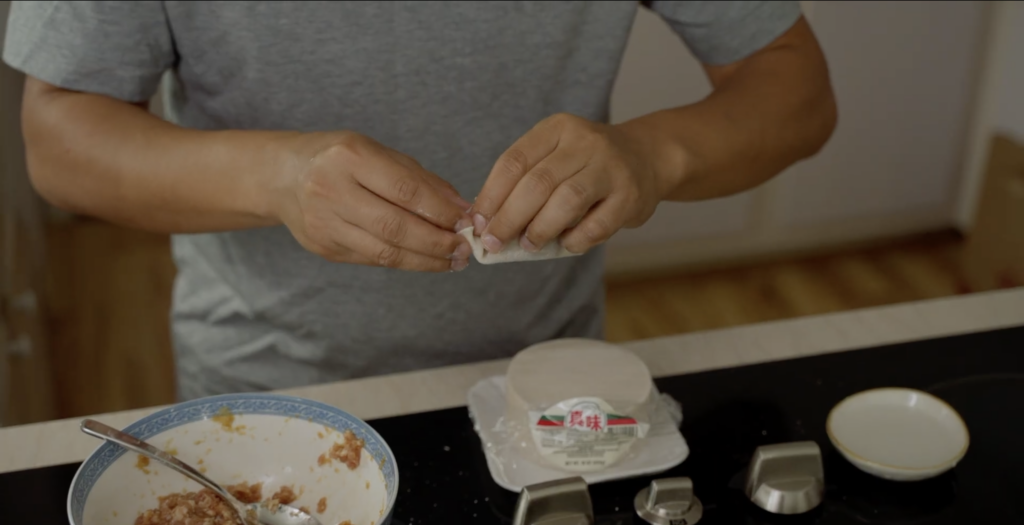
The bulk of the short is about Siwei and his group of colorful classmates learning Mandarin as Siwei experiments with recipes in the cookbook. The small group of people he meets in class are given colorful details, including a young woman who is into cosplay. (The film’s title is, of course, a reference to another colorful group of characters who bond during a class, The Breakfast Club.) The classroom scenes alternate with scenes of cooking, which are the real filmmaking highlight: Tjuata patiently shows Siwei combining ingredients and cooking them over a stove, set with an expressive score by Chris Hon.
Tjuatja wrote the script based heavily on the experiences of star Siwei Kwok. In fact, the house used for the scenes at character Siwei’s house, as well as some of the mementos (including photographs) are actually the actor’s. Much of the cast are real-life friends of Tjuatja’s and non-professional actors. As with many films that feature non-professional actors who have pre-existing bonds, the chemistry and guileless screen presence of the actors makes for a inviting, lived-in texture.
One of the film’s most memorable exchanges is a discussion in the classroom discussing how slightly different intonations in Mandarin can result in wildly different meanings: e.g. someone ordering a beer might accidentally order a beer. Tjuatja echoes this with Siwei reflecting over voiceover that his parents’ house feels “radioactive” — first intoned negatively, a lonely and life-sucking radiation; and second intoned positively, a place where love and connection radiate out and cover everything in contact with it.
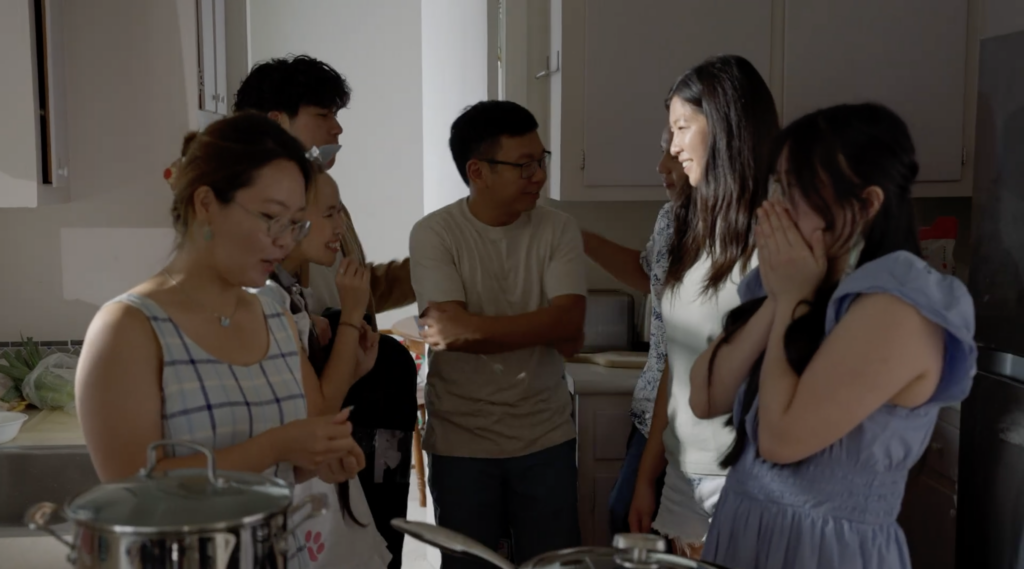
The film boasts a clear visual language and well-defined directorial personality for Tjuatja. The filmmaker prefers wide-angle, static shots without obvious focus points, and returning to the same shots at different time periods. The result works very well for The Dumpling Club, as we get a sense of Siwei’s loneliness early in the film, and really observe how environments change overtime — emptying of boxes, filling with people, etc. The scenes at Siwei’s house, especially, are selectively designed, with only a handful of repeated shots.
The final scene of the film depicts a family considering purchasing Siwei’s house and wondering what the future might hold for them, a lovely final note that emphasizes the cyclic nature of families growing and spreading in diaspora, only to find new communities and new homes.
The Dumpling Club is a warm and lightly funny, film about food, friends, and family intersecting as a young American explores his culture. It’s personally felt and well-constructed by writer-direct Tjuatja. It explores its themes with a delicate, savory touch.
The Dumpling Club screened at the Alexandria Film Festival on 11/13/2026 followed by a Q&A with writer-director Zulian Tjuatja and assistant camera Alex Au.
Find my complete coverage of the Alexandria Film Festival here.
Dan Stalcup is the film critic for The New Cinephile and The Goods. Reach him at dan.stalcup@gmail.com.