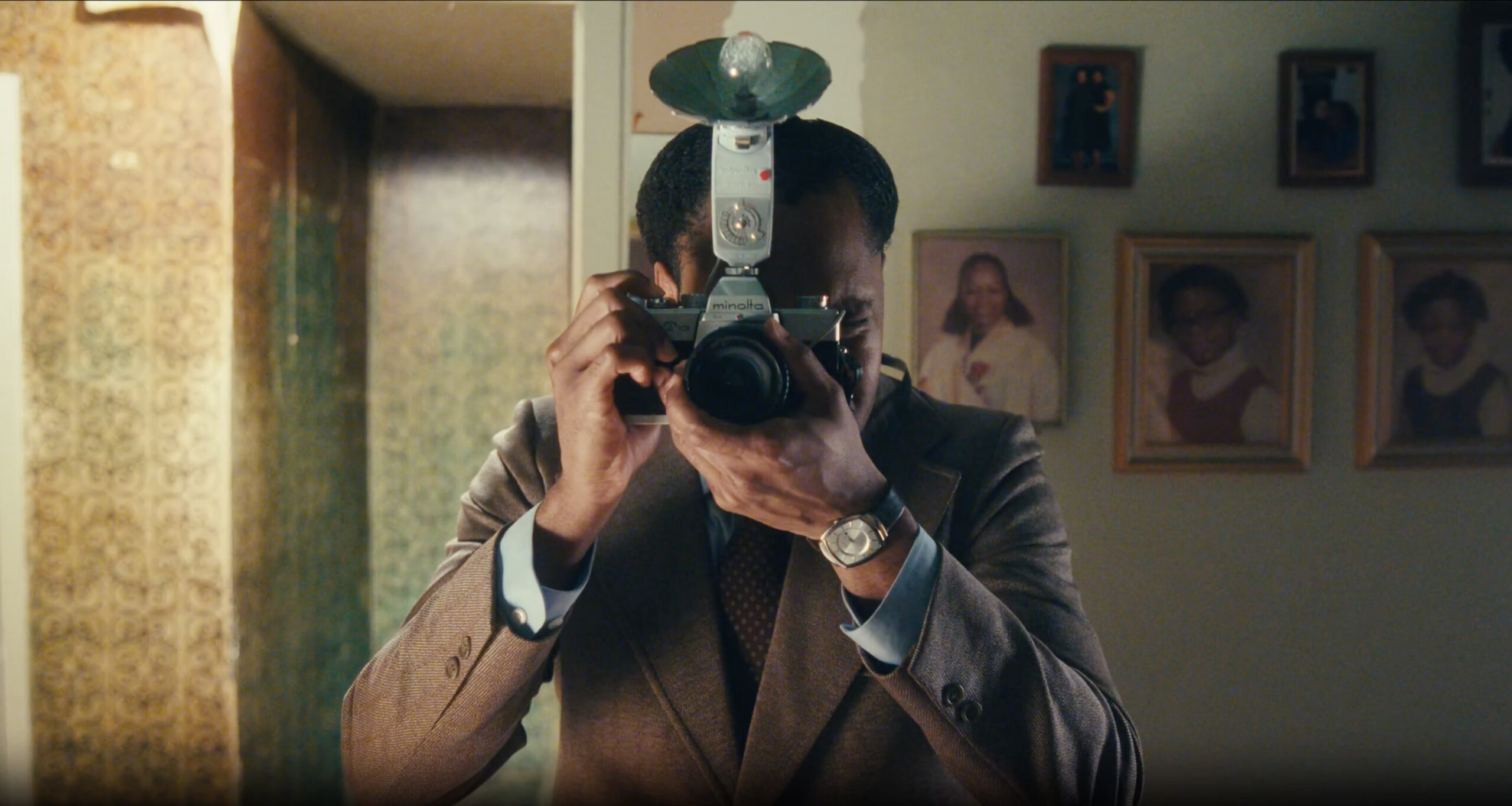
Documentary and fiction collide in Shawn Antoine II’s terrific short hybrid film The Sight Unseen. In 1971, six-year-old Sharon Wilson discovered a glowing cross in the bathroom window of her family’s Bronx apartment, a seemingly miraculous vision arriving at a dark moment for her community. Antoine alternates between interviews with the adult Wilson and a dramatic recreation of those events, set in a Bronx crumbling under crime and economic oppression, where young Black men are returning from Vietnam to find their neighborhood flooded with heroin.
Once the cross appears, the family’s life is turned upside down, as everyone sees something different even as they all see the same cross: Some see another opiate for poor Black people, a distraction from their real problems; others see a sign from God that this family and this community are blessed; others see a call to power, a burning cross turned back against the Klan to summon Black resistance; and still others see a way to make a few bucks during hard times.
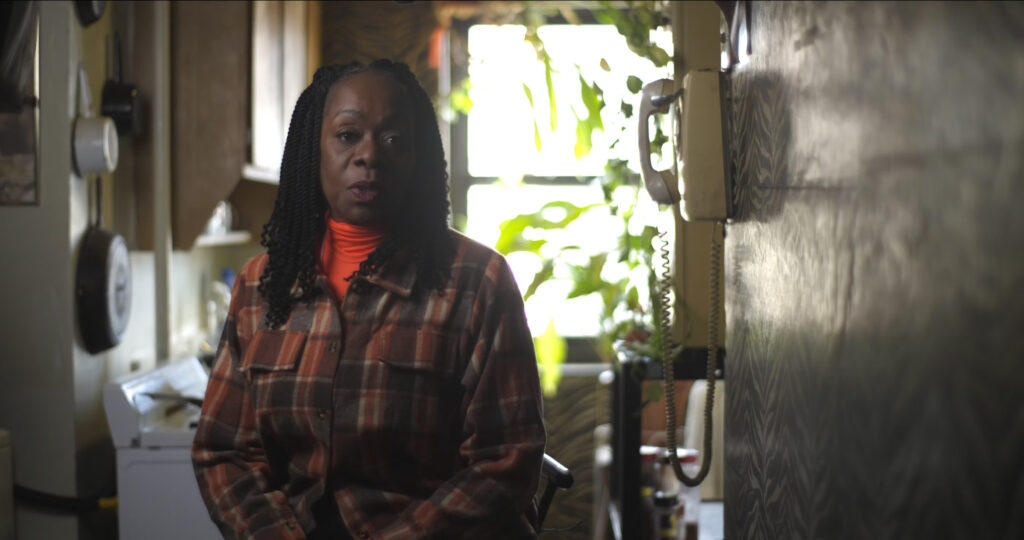
The Sight Unseen flows seamlessly between the dramatization and the documentary footage. Cutting between the recreated past and Wilson’s present-day testimony invokes the role of memory and perspective in a phenomenon that defies rational explanation like this one. The dramatization shows us how it might have looked; the interviews remind us that what we’re watching is how it was remembered, and what it came to mean.
The production design is superb, with costumes, props, hairstyles, and sets that all evoke the early ’70s. It’s all shot with an amber warmth that brings out the era’s textures: the wood-paneled walls, the incandescent glow, the unmistakable fashions.
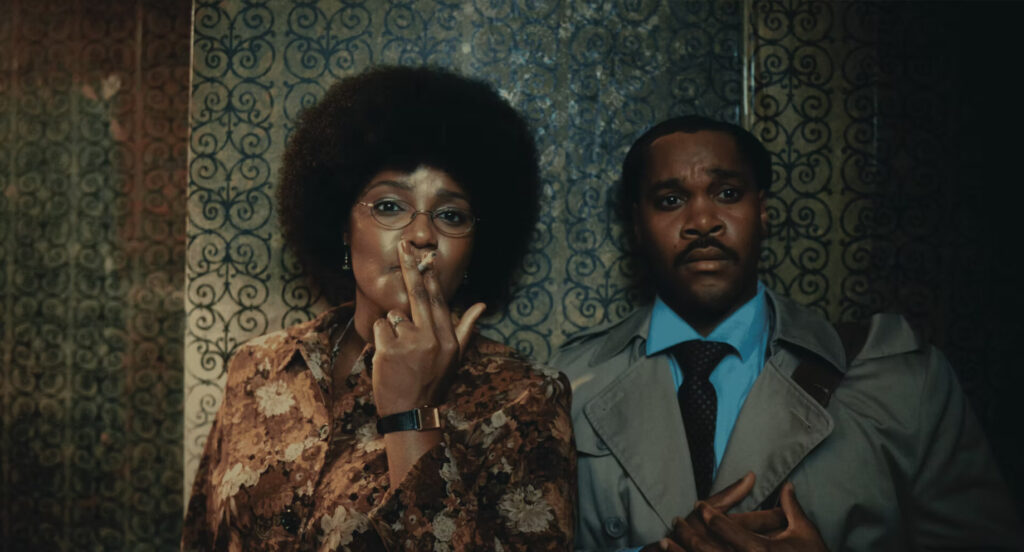
The cast is outstanding across the board. Among the figures in the dramatized portion is Melvin Tapley (Jared Kemp), a journalist with The Amsterdam News, a New York newspaper run by Black writers and editors and focused on Black issues. Kemp is excellent, capturing a writer reckoning with the complexity of the “hope vs. hoax” story he’s investigating. Equally strong is Sherrell Johnson as Pearl Wilson, Sharon’s mother, trying to hold her family together amid the tumult. Johnson has a powerful screen presence.
Antoine has built a body of work exploring Black life in Harlem, from For Those That Lived There, about gentrification and cultural legacy, to KINGDOME, a tribute to the neighborhood’s streetball culture. The Sight Unseen, made as part of his MFA work in documentary media at Northwestern, carries those concerns across the Harlem River and half a century back in time. His direction is confident and thematically ambitious: a cross-sectional investigation of both an event and a challenging cultural moment through a variety of lenses: political, religious, historical, and personal. The film is never too heavy, either. Antoine handles a wide range of tones (some moments, like a conversation between Pearl and her brother Ike played by Mister Fitzgerald, are quite funny) and makes sure it all holds together. From a craft perspective, he uses a variety of shots and techniques effectively and shows great instincts for making moments pop.
My favorite touch is how rarely we see the illuminated cross directly. More often, we see it in the eyes of the people looking at it, the cross shape glowing in their pupils — and always slightly differently, as Antoine had artists design a different cross to be reflected in each beholder’s eye. This is a striking image, and it’s the link to the title: The cross itself remains, in a sense, the sight unseen by the viewer. What Antoine shows us instead is the act of seeing. Every pair of eyes takes in the same shape and carries away a different meaning, and whether the cross was a miracle, a trick of the light, or a hoax ultimately matters less than what each witness made of it.
The Sight Unseen is an innovative documentary and drama film that blends a range of styles and ideas into a satisfying, informative, and provocative whole. Its story is at once a fascinating moment in America’s troubled history and something that echoes through today, as Black Americans continue to face inequity and to argue over how best to answer it. Antoine leads a talented crew and a charismatic cast, and I’m eager to see what he does next.
The Sight Unseen is a 39-minute documentary-drama hybrid film written and directed by Shawn Antoine II, featuring Sharon Wilson and starring Jared Kemp, Sherril Johnson, and Mister Fitzgerald. It was produced by Antoine, Korstiaan Vandiver, Sultan Ali, and Timothy Mendonca, with cinematography by David William and Marshall Wayne Cooper. You can find Antoine’s web site here. The film screened at the Alexandria Film Festival on 11/13/2026.
Find my complete coverage of the Alexandria Film Festival here.
Dan Stalcup is the film critic for The New Cinephile and The Goods. Reach him at dan.stalcup@gmail.com.